
For game‑related products, Kwai is rapidly becoming a high‑value traffic source in emerging markets such as Latin America, Southeast Asia, and the Middle East. By designing a structured media buying strategy, advertisers can use Kwai to acquire high‑quality users at a competitive cost while complementing existing channels like Meta, Google, and TikTok.
When planning Kwai campaigns for game‑focused products the core idea is to start narrow and then scale. In other words, begin with small, data‑driven tests to identify the best combinations of countries, audiences, ad formats, and creatives, and then gradually increase budgets once performance stabilizes.
Partner Advantage: By working with a professional partner such as KoinWave, advertisers can complete Kwai account setup, tracking implementation, and baseline structure design more quickly, which shortens the time from "initial exploration" to "stable performance".
For game‑related products, Kwai performs especially well in markets where the platform has strong penetration and high user engagement. These typically include:
In the first phase, it is advisable to focus on one or two core markets (for example Brazil + Indonesia), use a modest budget to run intensive tests, and identify the most promising combinations of targeting and creatives. In the second phase, once the model is validated, you can replicate winning setups across additional countries.
Kwai provides multidimensional targeting options across age, gender, location, and interests, which works particularly well for game‑related audiences. For most game‑focused products, a good starting point is:
Geographic Strategy: Begin with key cities and economically developed regions where users tend to have stronger purchasing power and more stable network conditions. Once performance is validated, you can expand to secondary regions.

Kwai users are accustomed to fast‑paced, highly engaging short‑form content. For game‑related advertising, the first three seconds of your video are critical: they must capture attention and instantly convey the core promise of your product.
To build a robust creative pool, prepare at least three core creative directions ("creative buckets") and generate multiple variations under each:
Creative Testing: For each direction, prepare at least three to five video creatives with different thumbnails, titles, and subtitles, so you can run parallel A/B tests and quickly identify top‑performing concepts.
Localization strongly affects performance on Kwai, especially in markets like Brazil and Indonesia:
| Element | Best Practice | Impact |
|---|---|---|
| Language | Use local languages (Portuguese, Spanish, Indonesian, etc.) instead of relying solely on English | Native expressions and internet slang can significantly boost engagement |
| Voiceover & Subtitles | Combine local voiceovers with clear subtitles | Voiceover can be casual and conversational, matching local content creators' tone |
| Sound & Music | Genre-specific audio design |
Slots and casual games should highlight reward sounds (jackpot, chain reactions) to amplify the
feeling of winning.
Action and strategy games benefit from intense background music and impactful sound effects (explosions, hits, skill sounds). |
A clear account structure helps you manage campaigns, scale efficiently, and analyze data more effectively. Ideally, you design your structure at the account setup stage.
Structure Setup: If you work with KoinWave to open and manage your Kwai account, this structure can be set up from day one, minimizing later restructuring and ensuring data consistency across tests.

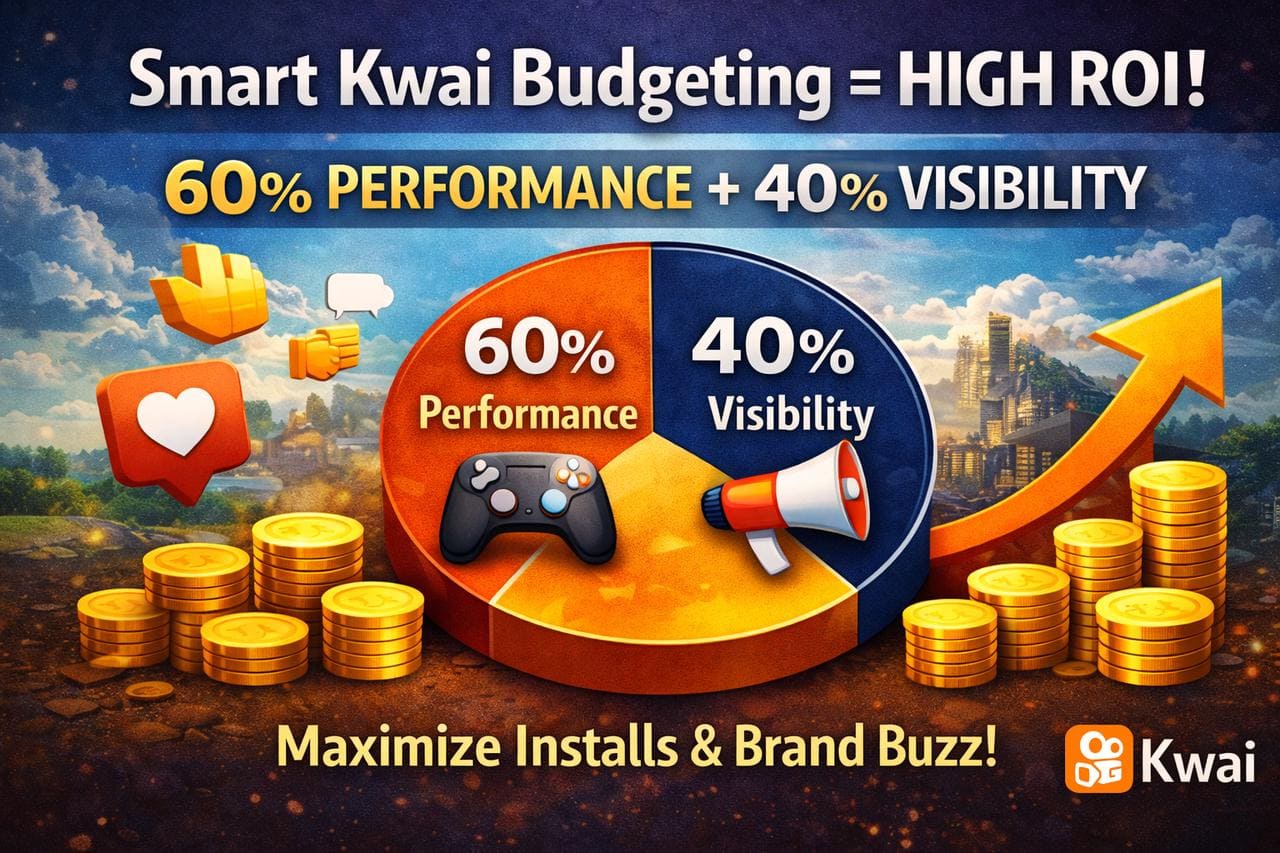
A practical approach for game‑focused advertisers is to blend performance and branding budgets:
| Budget Type | Allocation | Campaign Types | Purpose |
|---|---|---|---|
| Performance Budget | ~60% | In‑feed ads, native ads, app install campaigns | Optimized for installs, registrations, or qualified leads |
| Visibility Budget | ~40% | Splash ads, brand challenges, high‑impact placements | Lift brand awareness and organic traffic |
User activity patterns vary by market. For example, in Brazil, Kwai usage tends to peak in the evening and on weekends. You can:
Once the basic structure is running, the focus shifts to continuous optimization and controlled scaling.
Important metrics include:
| Metric | What It Measures | Why It Matters |
|---|---|---|
| Impressions & CTR | Creative attractiveness and audience relevance | Indicates how well your ads capture attention |
| Installs & CPI | Acquisition cost and scale potential | Shows cost efficiency and growth capacity |
| Registration & Onboarding | Landing page quality and early game experience | Reflects user engagement quality |
| CVR & ROAS | Campaign profitability over time | Determines long‑term success and ROI |
Data Integration: You should integrate Kwai data with your internal analytics or MMP so you can evaluate performance by cohort, region, and creative.
Adopt a disciplined A/B testing approach:
Testing Duration: Each test should run long enough to reach a statistically meaningful volume; for most advertisers, a three to seven‑day testing window per iteration is a practical benchmark.
For many teams, the main challenge is not deciding whether to use Kwai, but knowing how to design, launch, and optimize campaigns efficiently. This is where a specialized partner like KoinWave can provide real leverage.
If your 2025 growth plan includes new users in Latin America, Southeast Asia, or other emerging markets, building a structured Kwai strategy for your game‑related products, and executing it with KoinWave's account opening and media‑buying service, is one of the most effective ways to unlock incremental growth and diversify your overall channel mix.
Ready to Get Started?
Let's accelerate your campaigns together.
© All Rights Reserved by Koinwave