2026 Kwai Game Ad Budget Strategy: Phased Allocation Guide
I. Why Must Game Advertisers Prioritize Kwai’s “Phased Budget Allocation” in 2026?
As we enter 2026, the competitive landscape for game user acquisition has become even more intense than in previous years: traffic costs +20-35% on major platforms continue to rise, growth in emerging markets is slowing, and regulatory and privacy policies are constantly tightening.
For game teams, simply “spending more” is no longer a solution; rather, it accelerates budget waste. Against this backdrop, implementing phased budget allocation on platforms like Kwai which still offer considerable growth potential has become key to managing risk and maximizing returns.
This is particularly true for gaming products (including gambling/betting, card games, casual mini-games, and idle games both Category B and general gaming products). In regions like Latin America and Southeast Asia, Kwai boasts a large base of users in lower tier markets and relatively low competition. This makes it ideal for implementing precise phased budget allocation, allowing you to spend money on areas with a higher likelihood of success rather than blindly pouring resources into the market from the start.
Before that, however, there is a more fundamental issue: to achieve truly controllable and adjustable phased budget allocation, a stable and functional Kwai gaming ad account is a prerequisite. Therefore, “opening a Kwai gaming ad account” and “opening a gaming ad account through a professional agency” naturally become part of the overall advertising strategy. Official partner agencies like KoinWave can make this process faster, more stable, and safer.
II. The Foundation of Phased Budget Allocation: First, Secure a Compliant and Manageable Kwai Gaming Ad Account
Before discussing how to allocate the budget, we must first address the questions of “where the money will be spent” and “whether it can be spent at all” which brings us to the issue of the Kwai ad account.
1. Common Challenges Game Advertisers Face When Opening Accounts
Many game teams planning to ramp up their Kwai campaigns in 2026 will encounter similar issues:
- Attempting to register a Kwai advertising account independently, only to have their application rejected after multiple rounds of document submissions;
- Games falling under Category B (such as gambling, betting, or card/board game mechanics), making it difficult to open an account through standard channels;
- Lack of familiarity with local policies and platform compliance requirements, leading to concerns that creative assets or landing pages might violate regulations and jeopardize the entire account’s security;
- The need to run campaigns across multiple countries and game titles, yet lacking a unified advertising account management system, resulting in chaotic budget switching and management.
Direct impact: If the account is unstable, frequently flagged by risk control, or subject to spending limits, even the most refined budget models and phased plans cannot be effectively implemented.
2. The Benefits of Using a Professional Agency to Open a Kwai Gaming Ad Account
Consequently, an increasing number of gaming advertisers are choosing to use a “Kwai ad account opening agency” to handle the initial setup process, particularly for highly sensitive products such as gaming and gambling.
Take KoinWave as an example. As an agency specializing in ad account onboarding services, we have accumulated extensive experience with game account openings on the Kwai platform. Our specific advantages include:
- Familiarity with game-specific review criteria: We know which themes, elements, and creative expressions are more likely to pass review, helping you filter out high risk content in advance;
- Organizing and optimizing account setup materials: Providing modification suggestions regarding the company entity, website domain, game description, and landing page content to increase the first-pass approval rate;
- Leveraging official channels: Submitting account applications through officially recognized agency channels, which typically results in significantly faster review times compared to fully self-service modes;
- Multi platform coordination: In addition to setting up Kwai gaming ad accounts, we can also assist with account setup on platforms such as BIGO Ads, MediaGo, and Mintegral, facilitating cross platform budget coordination later on.
In other words, if you wish to implement precise, phased budget allocation on Kwai, your first step should be to consider opening a “game advertising account” through an agency like KoinWave. This ensures you have a functional, compliant, and secure account infrastructure in place before discussing how to scientifically allocate budgets across different phases.
III. Understanding the Game Advertising Lifecycle: A Logical Framework for Phased Budgeting
It is crucial to understand why budgets should be allocated in phases.
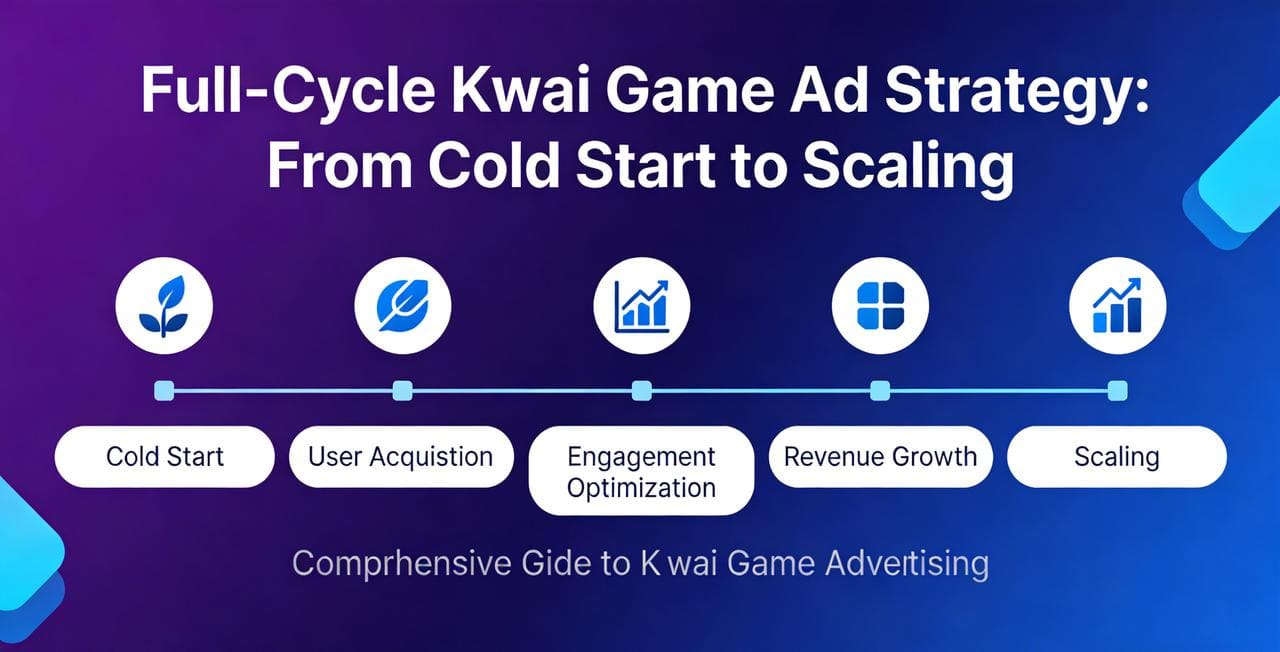
Game advertising campaigns on Kwai typically go through four key phases:
Cold Start Phase: Validate the fit between the market and the game’s theme.
Growth Phase: Transition from volume growth to quality and ROI optimization.
Scaling Phase: Expand the budget while maintaining an acceptable ROI.
Stable Operation Phase: Continuously refine ROI and LTV through structural optimization.
Each phase has distinct core objectives and different budget requirements:
Cold Start: rapid direction finding (some waste)
Ramp Up: value for money, machine learning
Scale Up: expand with ROI control
Stable: efficiency & creative iteration
In 2026, while Kwai’s competitive environment remains more favorable than some mature platforms, it is no longer a case of “any ad spend yielding returns.” Therefore, planning the entire lifecycle around the concept of “phase objectives + phase budget coefficients” is the key to ensuring game advertising campaigns “survive, scale, and generate long-term profits.”
IV. Phased Budget Model for Kwai Game Campaigns in 2026
Assuming your project’s total budget on Kwai is 100 (whether that’s 100,000, 1,000,000, or 10,000,000, you can adjust the figures proportionally), we can first outline a general allocation model and then fine-tune it based on actual conditions.
A common allocation structure might look like this:
These percentages are not fixed standards but rather a reference range. The real key lies in: How to allocate the budget within each phase across which countries, campaigns, creatives, and audiences; how to promptly redirect budget to “better performing audiences” if a particular channel underperforms; and how to temporarily adjust phase budget weights during specific events (such as major tournaments, holidays, or major game updates).
Next, we will break down the budget planning approach for each phase in Kwai’s 2026 game advertising campaigns, interspersed with practical guidance on how to implement these strategies.
V. Phase 1: Cold Start Phase — Use 20%–30% of the Budget to Quickly Find Your “Direction”
1. Phase Objectives
The core of the cold start phase isn’t about how much money you make, but about validating three key questions:
- Is there a “business opportunity” for this game in the target market?
- Which countries/regions show the most potential?
- Which creative direction, audience targeting, and bidding strategy is most likely to yield initial results?
Therefore, the budget strategy for the cold start phase can be summarized as: diversified testing + rapid screening.
2. Budget Allocation Recommendations
Assuming a total budget of 100, allocate 20–30 to the cold start phase:
- Geographic Level: Focus on 2–3 core countries; allocate 5–10 of the budget to each country to test different combinations.
- Account Structure Level: Within your Kwai gaming ad account, create at least 2–3 campaigns for each country (installs vs registration/initial payment). Divide each campaign into 3–5 ad groups testing different targeting options and bid levels.
- Creative Level: Prepare at least 8–12 video creatives covering different styles: pure gameplay, live-action, influencer recommendations, revenue focused scenarios; include 1–2 sets of Playable Ads.
Strategy: It’s better to run more combinations with smaller budgets than to tie up funds too early in a few “presumed winning” solutions.
3. The Value of Collaborating with KoinWave
During the cold start phase, game teams are most prone to falling into two common pitfalls: First, non compliant creatives, leading to mass ad rejections or directly impacting account scores; Second, disorganized account structures, making it difficult to optimize budgets later on.
If you opened your Kwai game ad account through KoinWave:
- Have them review your first batch of creatives to ensure you don’t violate policies right from the start;
- Work together to design the basic campaign/ad group segmentation logic, ensuring that future budget adjustments won’t create chaos;
- Get initial budget allocation recommendations based on their experience serving other gaming clients, making your 20–30 cold start budget more efficient.
VI. Phase Two: Ramp Up Phase — Use 30%–35% of the Budget to Scale Up from “Direction” to “Scale”
After the cold start, you should have a general understanding of:
- Which countries show the most potential;
- Which basic targeting and creative directions perform better;
- The approximate levels of key metrics such as CPI, registration cost, and first time top up rate.
Next, you enter the “growth phase”: further increase your budget to provide the system with sufficient data for learning, while gradually shifting your focus from “volume alone” to “volume + quality.”
1. Phase Objectives
- Enable the system to gather more data on “relatively high quality ad combinations” to establish stable learning and delivery logic;
- Begin focusing on deep conversions (registrations, first time top-ups, and paid engagement) rather than just installs;
- Scale and replicate the high performing combinations identified during the cold start phase to gradually establish multiple “leverage points” capable of scaling up.
2-3x
budget increase for top 1-2 countries (gradual, based on data)
weekly
new creative ratio to prevent creative fatigue
2. Budget Allocation Recommendations
Assuming you plan to invest 30–35 in this phase:
- Geographic Level: Increase budget for 1–2 best cold start countries (priority markets); maintain testing budget for average performers.
- Account Level: Increase daily budget for high performers by 2–3x gradually; create new optimization campaigns targeting “registration/payment events”; reduce or pause underperformers.
- Creative Level: Iterate on top performing creatives; identify common traits and mass-produce; maintain weekly new creative ratio.
3. Link Deep Conversions to Budget
During the growth phase, budget allocation should no longer be tied solely to install volume but should focus more on ROI and deep conversion performance:
- Allocate more budget to campaign groups that generate higher registration rates and first time recharge rates within the same budget;
- Appropriately increase bids for high value markets and high value audiences to secure more prominent and higher-quality traffic;
- For underperforming groups that are consuming budget, decisively reduce their budget or even pause campaigns.
At this stage, communicate frequently with agency teams like KoinWave and have them help you make informed decisions based on actual data: Determine which groups you can “safely increase spending” on, and which ones require structural or creative optimization before increasing the budget rather than making decisions based on gut instinct.
VII. Phase 3: Scaling Phase — Replicate “Successful Models” Using 25%–35% of the Budget
Once the ramp-up phase has achieved a relatively stable ROI, and you clearly know which countries, campaigns, and creative combinations are profitable, you can move into the scaling phase.
1. Phase Objectives
- Significantly increase the overall budget without significantly compromising ROI;
- Replicate proven winning combinations across more audiences, markets, and ad formats;
- As the budget expands, establish more granular monitoring mechanisms to prevent “scaling up volume while running at a loss.”
2. Budget Allocation Recommendations
Assuming you allocate 25–35% of your budget to this phase:
- Geographic Expansion: Treat mature markets as “cash cows”; select 1–2 new markets for “second cold start”; establish three tier structure.
- Format Expansion: Supplement feed ads with Eyemax/splash, rewarded videos, KOL collaborations; retargeting to high value users.
- Account Structure: Isolate campaigns with above-average ROI into “priority scaling pool”; increase daily budgets by 20-30% and observe; if ROI drops, expand targeting or introduce new creatives.
3. Risk Control and Stop Loss Rules
There are two major risks to watch out for during the scaling phase:
- First, a sudden, drastic budget increase can trigger the system to relearn the campaign, causing costs to skyrocket;
- Second, campaigns that were originally performing well can be ruined by “forced budget increases.”
Therefore, establish simple, actionable rules in advance, such as:
- Do not increase the daily budget for a single ad group by more than 30% of the previous day’s budget;
- If CPI/CPA or ROAS exceeds the expected range (e.g., more than 30% below target), immediately reduce the budget or pause the campaign for observation;
- Ensure that at least 20% of the budget in each phase is dedicated to continuously testing new creatives to lay the groundwork for subsequent phases.
When establishing these rules, you can draw on KoinWave’s experience from previous game projects to help you design a “scaling phase monitoring dashboard” and “anomaly alert criteria” that are better suited to your game’s genre.
VIII. Phase Four: Stable Operations Phase — Balancing “Defense and Offense” with 10%–20% of the Budget
Once advertising on Kwai has reached a relatively stable state: When you know which markets and ad combinations consistently deliver good ROI over the long term, and the overall budget remains stable, you have entered the stable operations phase.
1. Phase Objectives
- While maintaining the current ROI, strive for “long-term operations”;
- Continue to identify opportunities for efficiency gains through structural optimization and creative iteration;
- Set aside a portion of the budget for exploring new versions, campaigns, and markets.
2. Budget Allocation Recommendations
The 10%–20% budget does not represent the “entire advertising budget,” but rather refers to “additional investment and experimental budget within a stable state.”
Overall approach:
- Maintain a relatively constant daily budget for core markets, making minor adjustments based on seasonality and campaign schedules;
- Allocate a fixed percentage of the budget (e.g., 10%–15%) monthly or quarterly specifically for:
- Testing new creative directions;
- Experimenting with new audience segments and targeting;
- Small scale trials in new countries or with new ad formats.
This prevents the entire account structure from becoming “stagnant and outdated.” Should the competitive landscape or user behavior shift, you will still have “new samples” and “new pathways” at your disposal.
3. Long-Term Partnerships and Agency Value
During stable operational periods, many people tend to think: “The account setup was completed long ago; the agency’s value has diminished.”
In fact, truly outstanding “Kwai ad account setup and strategy service providers,” such as KoinWave, do more than just set up an account for you. Over the long term, they can:
- Help you monitor Kwai platform policies and product updates, providing early warnings of new regulations and opportunities;
- Combine data from multiple platforms to provide more comprehensive budget adjustment recommendations (e.g., shifting part of the budget from one platform to Kwai, or vice versa);
- At key moments (such as major events, Black Friday, Christmas, New Year’s, etc.), work with you to develop budget campaign plans that balance “short-term volume growth” with “long term ROI stability.”
IX. Cross-Platform Perspective: How Should Phased Budgets on Kwai Be Coordinated with Other Channels?
In reality, game advertising campaigns rarely run on a single platform. Many teams run campaigns simultaneously on Kwai, BIGO Ads, TikTok, Google, Meta, and even DSPs (such as MediaGo, Mintegral, etc.), which raises the issue of cross-platform budget coordination.
1. Kwai’s Role in the Overall Media Mix
In 2026, Kwai typically plays one of the following roles in game user acquisition:
Cold Start Testing Ground
Mid Tier Supplement
Deep Localization Hub
Therefore, when designing the overall budget, consider: Adjusting Kwai’s allocation increasing or decreasing its share according to different stages of the game’s lifecycle, rather than maintaining a fixed proportion year round.
2. Leveraging KoinWave for Multi Platform Budget Coordination
Since KoinWave not only provides Kwai game ad account setup services but also covers multiple platforms such as Meta, Google, TikTok, BIGO Ads, and MediaGo, you can discuss overall budget allocation strategies through a single point of contact, rather than communicating separately with each platform.
For example:
- During the early launch phase, focus on cold-start testing using Kwai and a major platform, with a budget ratio of 3:7;
- Once Kwai demonstrates strong performance in certain markets, shift part of the budget from other high-cost platforms to achieve a 5:5 or 6:4 split;
- For themes that consistently underperform on certain platforms, quickly scale back the budget and concentrate spending on the combinations that are performing better on Kwai.
This cross platform coordinated adjustment, combined with a “phased budget allocation” approach, can make your overall campaign performance curve smoother and more controllable.
X. Action Checklist: How to Develop a Phased Budget Plan for Kwai Game Advertising in 2026, Step by Step?
Finally, this concise checklist translates the concepts above into actionable steps. You can use it directly to formulate an internal plan or communicate with your team or agency.
1. Account Setup and Compliance Basics
- Define the overall 2026 Kwai budget and target market;
- Open a Kwai gaming ad account through a reliable agency such as KoinWave, while also considering accounts on platforms like BIGO Ads and MediaGo;
- Ensure tracking and event setup are complete, with key conversions such as installs, registrations, and first-time top-ups being properly reported.
2. Phased Goal Setting
- Define the timeframes and core metrics (e.g., installs, registration rate, CPA, ROAS) for the four phases: Cold Start, Ramp up, Scaling, and Stabilization;
- Estimate the budget allocation range for each phase (Cold Start 20%–30%, Ramp-up 30%–35%, Scaling 25%–35%, Stabilization 10%–20%; adjust as needed).
3. Cold Start Phase Execution
- Allocate budgets by country/region, create diverse campaigns and ad groups, and test as broadly as possible;
- Prepare creative assets across multiple directions to maintain sufficient testing density;
- Review data every 1–2 days to preliminarily identify high-performing combinations.
4. Ramp-up Phase Execution
- Gradually increase budgets for high-performing combinations and begin transitioning to deep conversion optimization goals;
- Bundle high-ROI targeting and creative assets into priority ad groups;
- Maintain continuous creative iteration and audience expansion to prepare for the next scaling phase.
5. Scaling Phase Execution
- Concentrate the budget on validated “profitable combinations” and control daily budget increases;
- Moderately expand into new markets and ad formats to avoid a single channel reaching its peak too early;
- Establish simple, easy to execute stop-loss rules to prevent ROI collapse.
6. Stable Operation Phase Execution
- Maintain stable ad spending in core markets, making minor adjustments based on holidays, events, and version release schedules;
- Allocate a fixed percentage of the budget to testing new creatives, audiences, and markets to prevent campaign stagnation;
- Maintain regular communication with your agency to promptly address changes in platform policies and the competitive landscape.
If you’re planning to ramp up your Kwai gaming campaigns in 2026, consider “phased budget allocation” as your core strategy. From cold start to scaling up, and from account setup to cross platform coordination, build a budget rhythm tailored to your game product step by step.
By partnering with a professional “game ad account setup” service provider, such as KoinWave, you can not only streamline the Kwai game ad account setup process improving approval rates and ensuring compliance but also receive expert budget and strategy recommendations at every stage of your campaign. This ensures every dollar is spent where it’s most likely to deliver a breakthrough.